"We got somethin', we both know it, we don't talk too much about it"
Tom Petty, Refugee
Talkin' about Refugees:
Public opinion, Social Distance,
Personal Responsibility, and Risk
- Tim Kubal, Feb 10, 2017
Refugees flee their own country's violence and seek safe haven in other countries. There is a long humanitarian ethic in the United States and elsewhere that suggests we should support refugees. However, there are many social forces that impede this generous ethic.

Within his first 2 weeks in office, Trump instituted a 90 day hold on immigration from six countries and an outright ban on all refugees from Syria. This was done supposedly in the name of national security, not based on religion, but the list includes only Muslim-majority nations and includes exceptions for Christians from these countries. U.S. Attorney General Yates refused to support the order, calling it “illegal,” which prompted a swift "you're fired" from Trump. As of Thursday Feb 9th, the Muslim Ban, as it has been called, has been temporarily stopped by two different levels of judicial review. While some have said this case would go to the U.S. Supreme Court, it is more likely that Trump will rewrite the document in a way that follows the constitution. This appears likely given that the case would probably lose at the Supreme Court, and Trump does not want to look bad again after bungling the release of the original decree that was struck down by several courts, including appeals, and he may also be wishing to recover from calling the judges that ruled on the case "so called" judges and comparing them to schoolchildren. Even his own Supreme Court nominee was bothered by Trump's disrespect for the law that was expressed in Trump's tweets.
The U.S. has a very strict refugee settlement system, and typically in the last few years has admitted only about 80,000 people per year, which is about .02% of the U.S. population. Crimes from refugees are almost non-existent and there is no evidence of any recent U.S. refugees becoming terrorists. In Europe it is a slightly different story, where terrorists did infiltrate refugee flows in France and Germany. These refugee flows have grown immensely in the past few years.
This essay discusses the refugee issue by highlighting changes in public opinion, social distance scales, as well as arguments about personal responsibility and risk.
Public Opinion and Social Distance
Recent polls from Gallup and others, taken before Trump's hastily released and highly-protested travel ban, found that over half of Americans don’t want to accept any Syrian refugees at all; almost half said they would exclude Christian refugees from Syria too. Dozens of governors promised to oppose Syrian refugees in their state. Other polls found slightly more support, such as the Brookings poll that showed 59% of Americans support Syrian refugee settlement. Experts agree that there are obvious blowback issues, in terms of motivating our enemies and angering potential allies.

But the possible blowback doesn't seem to have a dramatic influence on public opinion. Humans have a natural tendency to distrust those defined as outsiders, and this fear has emerged repeatedly throughout U.S. history. Critical stances toward refugees has always been an American norm, beginning most popularly with the Know-Nothings of the 1800's,
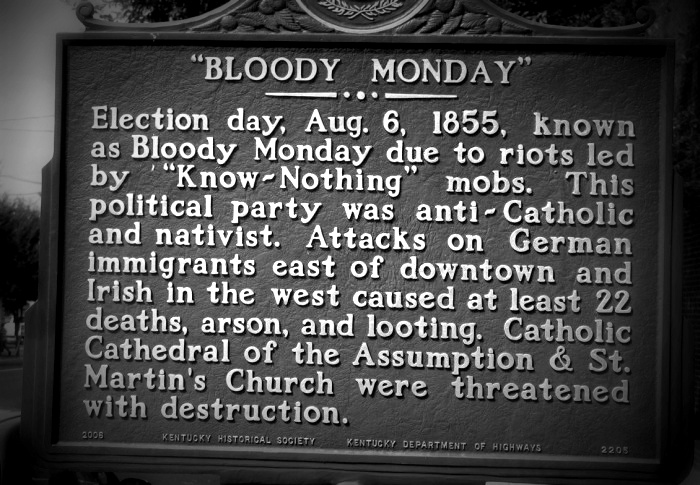
The groups defined as outsiders, of course, have changed considerably over the years. The roper center for public opinion research is an excellent source for access to historical trends in public opinion, and Gallup provides additional detail, as described below.
Before and during WWII, support for European refugees was limited. A 1938 Roper poll found that 67% opposed “German, Austrian and other political refugees” coming to the U.S., versus 18% who would allow them to come and 5% who would encourage them to come. In 1939, Gallup found similar opposition when it asked about “10,000 refugee children from Germany” coming to the United States." In a 1948 Gallup poll 57% disapproved of any plans to resettle displaced Europeans. Nonetheless, in 1948 Congress passed the Displaced Persons Act, which led to resettlement of 415,000 European refugees (mostly from Eastern Europe and Soviet Union) - far above normal immigration quotas.
After the Hungarian uprising of 1956, the Soviet Union responded with a fury and created a new refugee crisis. In 1958, Gallup found that more than half (55%) disapproved of resettling Hungarian refugees, with only 33% approved of it. About 30,000 Hungarians were admitted under the Hungarian Refugee Act of 1958.
The Vietnam war created another refugee crisis. After South Vietnam fell in 1975, the U.S. government gave refugee status to about 130,000 people fleeing from Vietnam, Cambodia and Laos. In a 1975 Harris poll, 37% were in favor, 49% opposed, and 14% weren’t sure. In 1979 President Carter doubled the number of these refugees the U.S. had previously agreed to accept, to 14,000 a month. Public opinion was not supportive. A New York Times poll showed that 62% disapproved of Carter’s action, but this did not stop the half million refugees that came from Vietnam, Cambodia and Laos that were admitted into the U.S throughout the 1980's.
In 1980, the U.S. accepted over 100,000 Cuban refugees, many of whom were recently released from Cuban jails. This came to be known as the "Mariel Boatlift," and it was unpopular in public opinion -- A 1980 poll showed that 71% opposed Cuban refugee settlement in the U.S. In 1994, over 100,000 refugees fled Cuba and Haiti; only 15% approved of Cuban resettlement, and 19% approved of Haitian resettlement, and the government responded equally harshly by intercepting the refugees at sea, interning them at Guantanamo Bay, and sending about half of them back home.
In 1999, a refugee crisis rose after prolonged fighting between Yugoslovia and the Kosovo Liberation Army. The U.S. accepted almost 20,000 Kosovar refugees, but public opinion was split (and still negative) - only 40% said accepting the refugees was the right thing for the U.S. to do.
The U.S. is a country of immigrants, and known for our welcoming attitude toward immigrants, as evidenced by our diverse population and icons such as the Statue of Liberty.

Public opinion, however, has been much more hesitant to support opening our borders to refugees. Its not surprising to see this level of ambivalence and fear, given our natural human tendency to distrust outsiders, and the long-standing distrust of Muslims and people from the Middle East, who repeatedly show up as the groups with the worst scores on the social distance scale.
The Bogardus social distance scale measures people's willingness to participate in varying degrees of social contacts with members of diverse racial and ethnic groups. It was originally developed in the 1950's and has been administered many times since. The willingness to support Europeans over non-Europeans has remained relatively stable even in the modern era,

Recent research on the social distance scale shows that the average distance between groups has decreased, and the average distance between the most and least trusted groups has also decreased over the decades.
This pattern of increasing acceptance has recently reappeared after the release of the travel ban. Despite the history of anti-refugee and anti-Arab bias, it appears that Trump's "Muslim ban" as critics have successfully labeled it, may have gone too far for most people. There may be a bit of a backlash brewing over Trump's aggressive move, as new polls show that a majority of Americans support opening our borders to the refugees. Conservative pundit Charles Krauthammer acknowledged that "overshooting on the travel ban is flipping public opinion on refugees." Actually, it is not that simple. It is clearer that there remains significant Islamophobia mixed with quite a bit of ambivalence.

The poll being referenced is a CNN poll released about 1 week after the announcement of Trump's ban. In it, 53 percent of the population opposes the Trump travel ban, including 88 percent of Democrats. Nothing surprising there. In contrast, only 12 percent of Republicans oppose the ban, and over half of Republicans want something even more expansive. Surprise -- another partisan divide. The divide even persists when the details about the rationales for the ban are specified. Does the ban reflect American values? Half of Americans and 81 percent of Democrats says no, while 43 percent of Americans (and 81 percent of Democrats) say banning refugees protects American values by keeping out people who don't support those values. Similarly, when asked if the travel ban makes the country safer, there is a clear divide -- 41 percent of Americans (and 83 percent of Republicans) say the travel ban makes the U.S. safer, and 46 percent of Americans (and 75 percent of Democrats, along with many expert analyses) believe it will make the country less safe, presumably because of the potential to alienate important allies, and motivate terrorists.
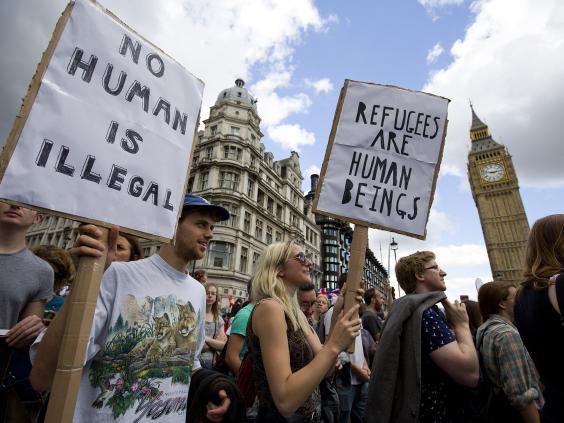
While there does seem to be a trend toward increasing tolerance toward (Arab or Muslim) refugees, there remains a great deal of ambivalence in public opinion. Perhaps part of this is the confusing argument equating opening our national borders to opening our individual homes.
Personal Responsibility
I've heard several people suggest that those citizens supporting asylum should welcome refugees into their homes. The argument is that its basically the same thing to open our country and open our homes, and that if someone believes so much in opening our borders, then they should "back it up" with some personal commitment to the cause.
It is an interesting argument. On the surface it definitely is the Christian thing to do, so it should resonate with many people, especially liberals who seem to love Jesus' works of mercy and mission to help the less fortunate.
Comparing opening the border to opening our homes is interesting, but its kind of hard to support the argument. Lets make the same argument about a different government program besides border security. The basic principle is that if we support a government program, we should not only say we vote to put government resources behind it, but we should take personal responsibility for that program too. So if we believe in having streets, then we should not only appropriate tax dollars, but also get out there and start volunteering to help the government patch them. The same thing goes for the mail, police, and all the other important services the government provides. If you want to keep these services, you should "back it up."
While actually a nice idea, there is no way that such behavior would become widespread unless it was mandated -- that's part of the tragedy of the commons: typically we do no little to nothing to preserve the common good.

Also, how far can we push the analogy that a country's borders are like your home -- homes are individually-owned, with individual liability, have an expectation of privacy, are not politically constructed geographic boundaries, etc. Most importantly, borders and immigration are social issues not private issues.
Just because we want to let refugees into our country doesn't mean it is our responsibility to house them. It would be an awful lot to ask private families to be responsible for housing refugees. Our government has a very powerful vetting process for ensuring only the safe refugees are given asylum, and our government can be burdened with transitional housing, because of our shared resources and our shared compact to help our fellow man.
Thankfully there are many generous corporations that are following the biblical message to help the less fortunate -- by providing temporary refuge, such as Airbnb offering free temporary shelter to all refugees stranded by Trump's order, or Ikea who is building them 10,000 temporary homes.
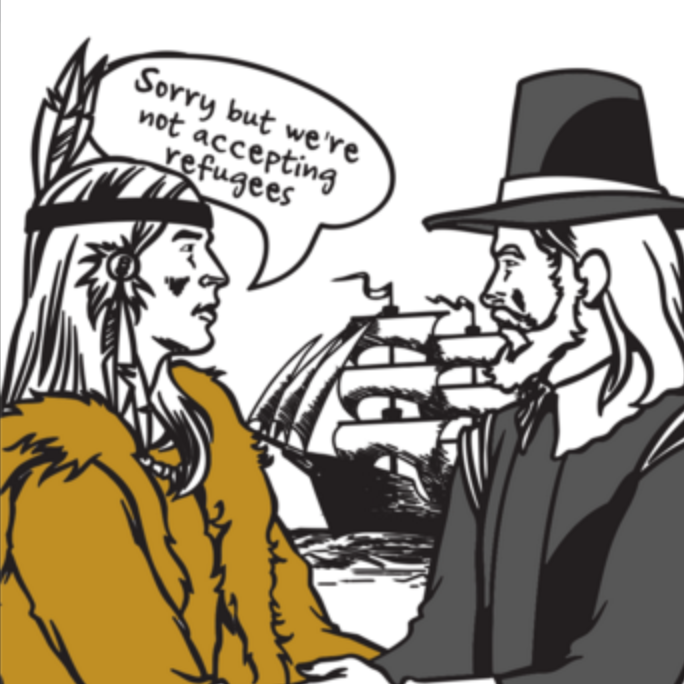
A common argument is that we should open our doors to fewer refugees. If we are to accept this argument -- how far back do we go? Many activists from the American Indian Movement say the U.S. is occupied territory and want to remind us that the earliest European settlers described themselves as refugees.
Today, many of us likely have a friend or neighbor that was a refugee from Russia. I just saw some statistics that said that Russian refugees are by far the largest refugee group in the last 20 years -- Russia is not an ally, and has had huge internal-terrorist problems for decades. Perhaps the tens of thousands of refugees from Russia should not have been let into our country?
Why not ban Saudi Arabia, where the September 11th bombers came from? Or Egypt, which has had some serious terror problems recently? There are dozens of other countries that could easily be added to the ban. The method of deciding about who to ban should be based largely on a real assessment of risk.
Getting Real about Risk
People from Somalia and Syria make up nearly half of the world's refugees. Maybe part of what we are doing through a Muslim ban is trying to find a justification for slowing down the massive influx of refugees from Somalia and Syria and using fear to justify our need for a functional limitation. This sort of wishful thinking seems necessary to retain any semblance of logic, especially in the face of what seems to be a common absurdity about the risk of actually facing a terrorist refugee.

Its not hard to look back just a few decades when we were taught to be so afraid of Japanese immigrants, and not long before that we were taught to be afraid of Italian and Irish and Jewish immigrants, all of whom, we were told, were going to bring crime and murder with them.
It is a dangerous world, and fear has helped conflate refugees and terrorists.

Trump said what has been widely described as the "Muslim ban" was driven by the need to protect Americans from terrorists coming from the countries he banned.
Is there a legitimate fear that U.S. citizens would be harmed by am immigrant or refugee terrorist?
Let's get real about risk.
The amount of U.S. civilians killed by all worldwide terrorist events each year is typically less than 30. It is dwarfed by real violent crime problems, such as firearm homicides, which are consistently killing above 10,000 U.S. citizens each year:

Terrorism within the United States is exceedingly rare. Only 318 events occurred between 1980 and 2005, according to the FBI,

The statistics suggest that less than an average of 13 terrorist incidents per year occur on U.S. soil. From 2004 to 2014, 303 Americans were killed in terrorist attacks worldwide, according to State Department reports, about 30 per year. During that same time frame, 320,523 Americans were killed because of gun violence, or about 30 thousand per year.
In the U.S., heart disease and cancer each kill about half a million people per year, and almost 50,000 people commit suicide each year. Still, it is hard to suggest the deaths from terrorism are not significant, given the fear terrorists successfully wished us to inflict on ourselves, from horrible events such as the death of 50 at the Miami nightclub last year. But its also striking that terrorism, through such a small amount of actual harm, engenders this much fear, and works so efficiently to justify unconstitutional government actions.

In the United States, the notion that we should be afraid of refugees, particularly from Muslim-majority nations, is popular, and is a core assumption supporting Trump's "Muslim ban." Yet, the FBI reported that only 6% of terrorism in the U.S. between 1980 and 2005, comes from Islamic terrorists.

So, lets recap: There are not many terrorist events each year and not many people die from terrorist events each year. And, Muslim terrorist events are a tiny proportion of the annual totals of terrorist events. The last remaining question is obvious -- there still must be a lot of terrorism from refugees, or from countries in the ban, right?
The ban would not have affected the terrorists responsible for any of the major Islamic terror attacks in recent U.S. history. In 1980, the government established the Refugee Act to screen refugees. Since 1980, how many thousands of refugees must have committed acts of terrorism? It must be a lot since the number motivated unconstitutional government action. Nope. Its not a big number. The number is zero. Even before 1980, there have only been less than five deaths from refugee terrorists.
Despite having almost no risk of succumbing to any terrorist violence, let alone Islamic-inspired terrorists, Gallup polls consistently show that between 30 and 50 percent of Americans are “very worried” or “somewhat worried” about Islamic terrorism in the U.S.
Talk about terror is rampant, and fear does benefit some groups of people. Professions such as politicians, journalists, and all the other folks in the military-industrial-media complex stand to benefit.

While not perfect, university faculty are less likely to personally benefit and are typically more trustworthy experts than politicians and their ilk. One excellent professor analyzed the data on terrorism in the U.S. from refugees.
Charles Kurzman, a sociology professor at the University of North Carolina and expert on terrorism in his 2106 report recently said that since 2001 no one has been killed in the United States in a terrorist attack by anyone who emigrated from or whose parents emigrated from Syria, Iraq, Iran, Libya, Somalia, Sudan and Yemen, the seven countries targeted in Trump's "Muslim ban".
So there is no chance that we are at risk of a terrorist attack from a refugee coming from one of these seven counties. Kurzman went on to say,
“My advice to the new administration would be to declare victory . . . your odds of being victimized by a terrorist attack are infinitesimal.”
Kurzman is not exaggerating. The chance of an American being killed in a terrorist attack caused by a refugee is 1 in 3.64 billion per year, according to the Cato Institute analysis. As a point of reference you are almost 4,000 times more likely to be hit by lightning than be a victim of a domestic terrorist attack by a refugee. The 3.64 billion number is an outcome of calculating that only 20 of the 3,252,493 refugees admitted from 1975 to the end of 2015 were terrorists, which amounted to 0.00062 percent of the total. Only three of the 20 were successful, killing a total of three people.
How could we react in fear and ignorance in response to something that brings such little physical harm? The simple answer is threefold: terrorism is a cheap and effective method of warfare, the propaganda that politicians spew to justify their agendas does not always fit the truth, and our fears don't always match real risk.
Feel free to leave your thoughtful comments below.
